
The beginning of the story about the main symbol of Disney
Mickey Mouse first appeared in the 1928 black-and-white cartoon “Steamboat Willie”, which premiered on November 18, 1928, at the then Colony Theater on Broadway. It was the first cartoon to use synchronized sounds when the movements on the screen match the music and sound effects.
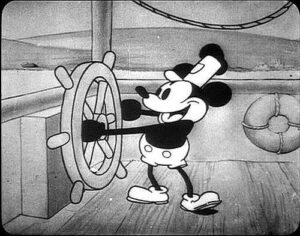 Creator – Walt Disney began his first series of fully animated films in 1927 with the character Oswald – the lucky rabbit. When his distributor appropriated the rights to the character, Disney changed Oswald’s appearance and created a new character, which he named Mortimer Mouse; at the insistence of his wife, Disney renamed him Mickey Mouse. Two silent Mickey Mouse cartoons – Crazy Airplane (1928) and Galloping Gaucho (1928) – were made before Disney adopted new sound for the third Mickey Mouse cartoon, Steamboat Willie (1928), although Mickey did not utter his first words (“Hot dogs!”) until “Carnival Kid” (1929). “Steamboat Willie” became an instant sensation and led to the studio’s dominance of the animation market for many years.
“It jumped out of my head and onto Whatman 20 years ago on a train ride from Manhattan to Hollywood, at a time when my brother Roy and I’s business success was at an all-time low and disaster seemed imminent”, – he wrote. Walt in a 1948 essay titled “What Mickey Means to Me.” The disaster Walt was referring to was the brazen theft of both his successful cartoon character Oswald the Lucky Rabbit and most of Disney’s artists at the hands of Universal distributor Charles Mintz. And who jumped out of Walt’s head? But it was Mickey Mouse!
Oddly enough, Mickey’s “official” birthday changed dates seemingly every year for decades after 1928. In 1933, Walt himself proclaimed: “Mickey Mouse will be five years old on Sunday. He was born on October 1, 1928. That was the date when work began on his first cartoon, so we let him consider that day his birthday.” This date was short-lived. From late September through December, Mickey’s birthday would often change to fit specific promotions. It wasn’t until 1978 that Dave Smith, founder of the Disney Archives, determined that the premiere of “Steamboat Willie” was indeed the first public appearance of Mickey Mouse, and thus the date of his birth.
This, of course, makes November 18, 1928 the birthday of Minnie Mouse, who was hurrying along the river bank at that time, trying to catch Pegleg Pete’s steamboat. Ever resourceful, Mickey found a way to drag her aboard even after the steamer had set sail. There was an instant connection between them, and the rest, as they say, is history.
 Mickey Mouse Protection Act
Steamboat Willie’s version of the iconic character will enter the public domain in 2024. But those who try to take advantage of it can find themselves in a legal mousetrap.
There is nothing surprising about the way Disney protects the characters it brings to life.
This company once forced a kindergarten in Florida to remove an unauthorized mural of Minnie Mouse. And in 2006, Disney told the mason that carving Winnie the Pooh into a child’s headstone would violate his copyright. The company pushed so hard for expanded copyright protection in 1998 that the result was derisively nicknamed the “Mickey Mouse Protection Act.”
Copyright Term Extension Act, abbreviated as CTEA, also known as the Sonny Bono Copyright Term Extension Act, Sonny Bono Act) or, ironically, the Mickey Mouse Protection Act (Mickey Mouse Protection Act) is a US federal law passed in 1998 that extended the term of copyright in the US.
When Mickey Mouse first appeared in 1928, Disney’s copyright had been protected for 56 years.
Everything changed dramatically in 1976, when the US Congress passed a law that is still the basis of copyright protection in the US. The document, among other things, extended the term of the right to the end of the author’s life plus 50 years, or 75 years from the date of publication of the work for companies and works without authorship.
But even such rather broad terms did not suit the Walt Disney company, because the symbol of the cartoon giant – the character Mickey Mouse – was created in 1928, and therefore the monopoly on it should have ended already in the early 2000s. The company has started promoting an initiative to change the legislation. At first, the property rights were demanded in perpetuity, but after long discussions, Disney’s lawyers made concessions. As a result, the so-called law “On Protection of Mickey Mouse” was adopted:
- the term of copyright is valid for the lifetime of the author + 70 years after the death of the author;
- for corporate authorship (ownership of rights) — up to 120 years after creation or 95 years after publication, whichever comes first.
 Limits on the use of the image of Mickey Mouse
Anonymous or pseudo-anonymous works of art can be owned for a maximum of 95 years, and for Mickey Mouse, created on October 01, 1928, that period is coming to an end. However, as media and entertainment lawyer Daniel Mayed points out, copyright expiration has its limitations.
“You will be able to use Mickey Mouse as it was originally created. However, if you do it in a way that makes people think of Disney – which is highly likely since they’ve invested in the character for a long time – then Disney could theoretically claim trademark infringement. Copyrights are limited in time, but trademarks (on the condition of payment for the extension of rights) are not”,- says the lawyer.
That is, it is this very first original version of the mouse that becomes public property. All other types of Mickey Mouse will only be available to the general public when they reach their age limit of 95. And certain features of the character, which are recognized as part of the Disney brand, may forever remain the property of the entertainment giant.
For example, catchphrases of characters or their signature clothes Disney will be able to use as its own trademark. Unlike copyrights, trademarks do not have an expiration date (subject to payment of state fees for extending the term of validity of rights).
 We will remind you that some Disney characters have already become public property. Among them is Winnie the Pooh, who may soon appear in an unexpected genre horror film based on a children’s fairy tale, due to be released on IMDb.
What about the rights to Mickey?
The copyright for just one Mickey Mouse image is expiring. It covers the original version of Mickey Mouse as seen in Steamboat Willie, 8 min. a short film with a small plot. This mute Mickey has a rat’s nose, rudimentary eyes (no pupils) and a long tail. He can be naughty. In one scene of “Steamboat Willie” he tortures a cat. In another, he uses a frightened goose as a trombone.
Later versions of the character remain in copyright, including the cuter, chubbier Mickey in red shorts and white gloves most familiar to audiences today. They will become public domain at various points in the coming decades.
“Disney regularly modernized the character without considering the specifics of copyright, at least initially, but to keep up with the times”,- said Jane K. Ginsburg, an intellectual property law authority who teaches at Columbia University.
The expiration of Steamboat Willie’s copyright means that the black-and-white short can be shown without Disney’s permission and even resold by third parties. (Perhaps there isn’t much resale value left, though. Disney put it up for free on YouTube years ago.) It also means that anyone can use the film and the original Mickey for further expression – to create new stories and artwork.
There’s a complication here: Disney also owns trademarks for its characters, including the “Steamboat Willie” version of Mickey Mouse, and trademarks (provided timely renewals are paid) never expire as long as the companies continue to file. Copyright applies to a specific work (unauthorized copying), and trademarks are intended to protect against consumer confusion (to give consumers confidence in the original source of the rights owner and the quality of the work).
As such, any use of the original Mickey, which is in the public domain, cannot be taken as coming from Disney, Ms. Ginsburg explained. That protection is strong, she added, because the character, even in its early form, has such a close association with the company. People look at these ears, smile and “automatically associate it with Disney,” the teacher emphasizes.
What legal possibilities await the image of Mickey Mouse ?
 In 2007, Walt Disney Animation Studios updated its logo to include the “Steamboat Willie” mouse. Since then, he has appeared before every film released by the studio, including Frozen and Encanto, deepening the old character’s association with the company. (The logo is also trademarked.) Disney also sells Steamboat Willie merchandise, including socks, backpacks, mugs, stickers, T-shirts, and collectibles.
The subject of Mickey Mouse and copyright has been in the public consciousness since the late 1990s, when Disney and other entertainment companies – and, most importantly, the legacy of composers such as George Gershwin – successfully lobbied Congress for expanded copyright protection. In many ways, Mickey has become the ultimate symbol of intellectual property, a character more famous than even Santa Claus, market researchers say.
The 1998 copyright extension sparked a legal battle in which opponents argued that Congress had ignored the US Constitution, which provides that copyright protection is granted for a “limited” time. According to Paul Goldstein, a professor at Stanford Law School and the author of a five-volume treatise on US copyright law, “Free the Mouse” stickers began to appear on bumpers.
“Disney was no more active in promoting the extension of the rights to its mouse than anyone else, but it was made a villain”.
Disney’s lawyers and lobbyists probably determined long ago that pressuring Congress for another extension would not succeed. “The last sequel went through with such a bad, bad smell”, – Mr. Goldstein said. “I don’t think there was any option to try to take it any further”.
 This means that early versions of Papaya,Goofy, King Kong, Donald Duck, Flash Gordon, Porky Pig and Superman will enter the public domain at various points over the next decade.
If there’s one thing Disney takes more seriously than intellectual property, it’s corporate image. In 2020, a Disney affiliate charged an elementary school $250 for showing The Lion King without permission at a benefit night. The media storm that followed was so intense that Robert A. Iger, the chief executive of Disney, apologized and said he would make a personal donation for such actions.
Over the past decade, Disney has also had to contend with the rise of a “creator culture,” Mr. Moss said. Digital technology has allowed creativity and expression to flourish online, with YouTube vloggers, Instagram influencers, TikTokers incorporating intellectual property into their new creations.
This could become a problem for Disney when Steamboat Willie becomes a public domain. “They won’t be able to prosecute everyone”, – Mr Moss said. It will be necessary to draw a front line”.
Ms. Ginsburg said she is watching closely to see if Disney and other entertainment companies try to use trademark law as a replacement or extension of copyright – as she put it, “to apply separate protections to get into the same place”.
In a 2003 Supreme Court intellectual property case involving 20th Century Fox, Justice Antonin Scalia, writing for the court, warned against the use of trademarks to create “a kind of mutant copyright.”
 “It’s a dangerous area”, – Ms. Ginsburg said. “We’re on the brink of a time when copyright on a whole range of visual works will expire”.
But the main question is still ahead – how creators can protect their rights under the influence of the development of artificial intelligence, algorithms regarding the use of unprotected images, outdated legal norms, lengthy court processes and the rapidity of time. Therefore, our advice at all times is to take care of several ways of protecting rights in order to be involved in different methods of their protection in the future. And our company of professionals will always help you to be one step ahead.
copyright / Disney / intellectual property / Mickey Mouse / trademark


