
When you can’t come up with your own distinctive name, you choose to parasitize on already well-known global brands. But patent law applies and a fair court decision can jeopardize not only your business, but also invalidate the trademark certificate you received.
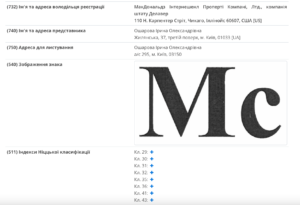 Since 1940, the American company has owned trademarks with the common word element Mc
The Pecherskyi District Court of Kyiv satisfied the claim of McDonald’s International Property Company Ltd. against Yevhen Leskiv from Kyiv and the state enterprise “Ukrainian Institute of Intellectual Property” (hereinafter – Ukrpatent), declaring the certificate of Ukraine for a mark for goods and services issued by Ukrpatent to be completely invalid (in other words – TM certificate) and make a publication about it in the State Register. The decision of the Pechersk District Court of Kyiv is dated October 6, 2022.
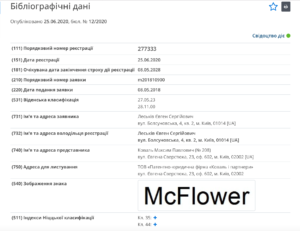
A world-renowned company sued a citizen of Ukraine over the McFlower trademark. Certificate No. 27733325 dated June 2020 was issued by Ukrpatent, which registered this trademark for Yevhen Leskiv. This sign was allowed to be used in business activities, in particular, in class 35 (abbreviated as advertising class) and class 44 (for flower business), and the validity of the certificate was established until May 8, 2028.
 Details of the court case and the arguments of the parties
However, McDonald’s considered such a bold registration a violation of the law on intellectual property. In particular, according to the plaintiff, people may confuse McFlower with a worldwide series (family) of trademarks (more than 80) with a common word element Mc. The American company focused on the fact that it has a presence in many countries of the world (and in Ukraine its trademarks were registered as early as 1995). That is, much earlier than even the disputed McFlower trademark was submitted for registration.
At the same time, the citizen of Ukraine asked the court to completely reject the claims. He explained that he does not use the McFlower trademark in a field related to the plaintiff (he wants registration specifically in class 35 – advertising in business activities). This brand is used exclusively for the sale of flowers and cannot in any way mislead customers, as McDonald’s is not a well-known company selling flowers and has never engaged in this type of business.
It is important that none of the parties to the proceedings appeared at the court session, but the court considered the case based on the documents and evidence available to it.
Instead, the court’s arguments played in favor of the American company. As it became clear during the trial, the element of Mc has been intensively and continuously used for more than 80 years since the creation of the McDonald’s company in 1940 all over the world, including the territory of Ukraine.
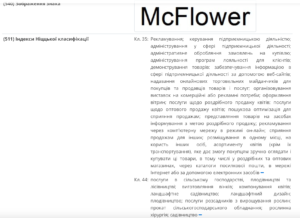 In addition, in the case, a conclusion from Ukrpatent was provided that TM Mc is a well-known mark for services of classes 29, 30 and 43, and therefore does not infringe the rights of TM McFlower having registration in classes 35 and 44. However, this examination is recognized as improper evidence, because it is scientific and technical before the application and does not comply with the provisions of Articles 102 and 106 of the Civil Code of Ukraine.
Therefore, the court took into account the conclusion of the forensic examination, which was appointed as part of the case review, regarding objects of intellectual property law dated December 21, 2020. According to the experts’ opinion, the McFlower trademark “is so similar that it can be confused with the proper McDonald’s International Property Company Ltd. – the well-known Mc trademark, which has enhanced legal protection compared to ordinary registered TMs.” Also, the disputed trademark may mislead consumers about the services provided by McDonald’s.
 Conclusions of the examination on the case
1) TM McFlower has an essential part “Mc”, which reproduces the well-known trademark “Mc” belonging to McDonald’s International Property Company, Ltd., a company of the state of Delaware.
2) All services of class 35, as well as such services of class 44 as making wreaths; arrangement of flowers, for which the trademark TM McFlower is registered according to the certificate dated June 25, 2020, are related to goods and services for which the trademark “Mc” is recognized as well-known in Ukraine,
3) With respect to all services of classes 35 and 44 listed in the McFlower TM certificate, the TM registered under said certificate is such as to be misleading as to the person providing the services,
As a result of conducting a comparative study, it was established that there are phonetic, visual and semantic similarities between the investigated designations, which determines the presence of similarities between them to the degree of confusion.
Thus, designations that are: identical or similar to the extent that they can be confused with the marks of other persons cannot be registered as trademarks, if these marks are protected without registration on the territory of Ukraine on the basis of international treaties of Ukraine, in particular, trademarks recognized as well known in accordance with Article 6 bis of the Paris Convention”.
The plaintiff also cites subsection 4.3.2.4 as justification for the requirements. Rules for drawing up, submitting and considering an application for the issuance of a certificate of Ukraine for a mark for goods and services, approved by the order of the State Patent Office of Ukraine dated July 28, 1995 No. 116 (as amended by the order of the State Patent Office of Ukraine dated August 20, 1997 No. 72) and registered in the Ministry of Justice of Ukraine on August 2, 1995 under No. 276/812 with subsequent changes and additions to the designation, according to which the declared designation as a mark is rejected from registration in the event of its identity or similarity to a mark protected in Ukraine in accordance with Art. 6 bis of the Paris Convention and the general knowledge of which is obvious.
The plaintiff notes that even before the date of submission by defendant 2 of the application for registration of the disputed TM McFlower McDonald’s International Property Company, Ltd. was already the owner of the well-known trademark “Mc” as of June 1, 2009. In addition, the plaintiff refers to Article 4 of the WIPO Recommendations, according to which “the mark is in conflict with a well-known mark, even when it is not completely, but also by its an essential part is the reproduction, imitation, translation or transliteration of a well-known mark, which is likely to cause confusion.”
 On the basis of the evidence collected in the case, including not only the opinion of the expert No. 202, but also, in particular, the survey of consumers regarding the goodwill of the trademark “Mc” dated December 2, 2016, the court came to the conclusion that the disputed TM McFlower due to inclusion in its the composition of the well-known trademark “Mc” of the Plaintiff is such that it can mislead consumers about the person who manufactures goods or provides a service in view of the registration, recognition of goodwill and intensive use of the previously registered and well-known trademark “Mc”, which in the vast majority of consumers, it is associated with McDonald’s restaurants.
Separately, the court ordered to collect UAH 26,925.50 court costs from Yevhen Leskiv (which include: the fee for filing a claim and application for preventive measures, costs for preparing an expert opinion) in favor of the American McDonald’s International Property Company, Ltd”.
And remember – our company does not just register TM for you, but also checks very carefully all possible risks so that there are no violations like in this case. We are waiting for your appeals and are happy to provide professional and prompt legal assistance regarding the protection of intellectual property rights.


