
 One of the objects of intellectual property is a font, the very font we are using to type this article, the font you use in your logo to label goods, advertise services, the font that pops up in a computer game window with additional explanations about the characters.
In the late 15th and early 16th centuries, a Venetian publisher named Ald Manucius printed and distributed cheap small books around the world. The reason for these cheap books was that the author began to use lettering that allowed more words to be placed on one page. Another interesting fact is that the artist and designer Tory Joffroy created a font that reflected the proportions of the ideal human form. It follows from the above that a font is the result of human intellectual activity.
Fonts are alphabetic characters (letters, punctuation marks) and numbers that have common patterns in their outlines. The history of the origin and development of fonts, the creation of various types of fonts dates back to ancient times, when there was a pictorial writing, which over time turned into a sound reproduction of a certain concept in the form of hieroglyphs. The creators of the oldest alphabet are considered to be the Hyksos. These were nomadic tribes who, after the conquest of Egypt, created their own writing system, which was based on the alphabet.
With the advent of computer technology, the font has become an object not only of handwritten and printed reproduction, but also of electronic (digital) reproduction. Electronic fonts become the property of software. These are separate fragments of design that are formed by program code and have a certain graphic representation. In many cases, even with all the digital tools we have today, it can take many months to create a new font.
 When a company decides to create a new logo or other marketing collateral, one of the most important decisions to be made is the font style in which the organization’s name should appear. Since the name of the organization is used in all communications, the font can help create a brand, corporate image, or vice versa, ruin the reputation if it is publicly proven that the font is the property of another person who did not grant the right to use this font to the company in any form.
When putting a new font into operation, it should be borne in mind that the graphical display of fonts and font software are different intellectual property objects and are subject to protection.
What you need to register a corporate font with copyright
- Surname, name and patronymic of the Author;
- Date of birth of the Author;
- Date of completion of work on the fonts – day, month, year;
- Provide the name of the author’s font;
- Provide the author’s address;
- Pay for the services of a legal advisor and state fees;
- Sign a power of attorney for the representation of your interests by a lawyer before the Ukrainian National Bureau of Intellectual Property;
- File with drawings and graphic images of the object – the font;
- Waiting from 3 months to receive the certificate.
Ukrainian law does not distinguish fonts as a separate object of intellectual property rights. The Civil Code of Ukraine provides for copyrights, in addition to an extensive list, for works of painting, architecture, sculpture and graphics, etc. “Graphics” is defined as an art form whose main visual medium is a monochromatic drawing. According to the nature and purpose, graphic works are divided into easel, book, poster, applied, and magazine and newspaper. Fonts belong to the latter.
In order for a certain type of font to be protected, two conditions must be met: an objective form of expression and originality, or creative character. The author’s property rights to a font as a work of graphics are preserved throughout his or her life and 70 years after death, while non-property rights are valid indefinitely.
 US law considers a font to be a software product. In some countries, laws stipulate that a font is both software and a graphic work. To understand the intricacies of licenses, you need to familiarize yourself with the EULA – End User License Agreement. This is an agreement (license) between the intellectual property right holder and the user.
International law provides for three types of font licenses based on the terms of use: “Free for personal use”, “Free for personal and commercial use” and “License purchase required”, as well as the main types by purpose: Desktop, Web and App.
Famous fonts in Ukraine
- Kyiv Region was created for the branding of the Kyiv region. The author of the font, Dmytro Rastvortsev, designed it in 2021. The font resembles the Old Ukrainian orthography, contains forms of semi-cursive and cursive scripts from Kievan Rus and the Baroque era, successfully combined with elements of 20th century constructivism. It is a free Ukrainian font available for commercial and non-commercial use.
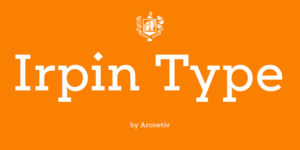
- Irpin Type is a font dedicated to the city of Irpin. It was designed by Oleksiy Popovtsev and inspired by the Ukrainian avant-garde of the twentieth century. Its geometric shapes are suitable for conveying a confident mood and look great on posters, logos or presentations. You can download Irpin Type Regular and Bold for free.
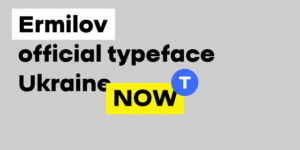
- Ermilov is probably the most recognizable typeface abroad. It was created by Kirill Tkachev for the official brand of Ukraine “Ukraine now” aimed at popularizing Ukrainian culture among the international community, developing tourism, and attracting investment. The typeface is named after the Ukrainian constructivist artist Vasyl Yermilov, whose work inspired the author.
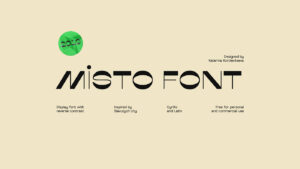
- Misto is a typeface with Ukrainian origins, designed by Kateryna Korolevtseva. This typeface is dedicated to Slavutych, the youngest city in Ukraine built after the Chernobyl accident. According to the author, she was inspired by the shapes of low, wide buildings and a museum sign with an unusual diacritical mark. As a result, the author managed to create a wide contrasting font with interesting rounded details that perfectly reflect the character of the city of Slavutych.
- Arsenal is a modern Ukrainian font in a business style. This font was designed by designer Andriy Shevchenko in 2012 for the first all-Ukrainian font typeface competition “Ukrainian Font”. The aim of the competition was to create a modern Ukrainian business font that would be popularized in Ukraine and abroad. Andriy Shevchenko won first place. The font was later added to the Google Fonts library.
 Font copyright is an important aspect of intellectual property that protects the creative and commercial interests of font designers. A typeface, like any other work of art, can be the result of considerable creative effort, and therefore a typeface is rightly subject to legal protection. In most jurisdictions, copyright in a typeface covers the design of the typeface, i.e. the specific appearance of the individual characters, but not the alphabetic characters themselves, which remain in the public domain.
At the same time, font licensing is a key mechanism that allows designers to control the use of their own works and receive remuneration for their intellectual labor. This may include a variety of license terms, such as restrictions on commercial use or the number of copies that can be made. Our lawyers will help you protect the copyright to the font you have designed and answer all your questions.


