
On March 8, 2023, the head of the Kyiv Metro, Viktor Braginsky, called for the renaming of five metro stations in the capital: “Druzhby Narodiv”, “Ploscha Lyova Tolstoho”, “Beresteyska”, “Minska”, and “Heroiv Dnipra”. The purpose of the renaming was to remove associations with the Russian Federation, Belarus, and the Soviet Union.
 On January 11, 2023, the Kyiv Digital app ended voting on the renaming of certain city facilities, including metro stations. On May 18, 2023, Kyiv City Council members supported the renaming.
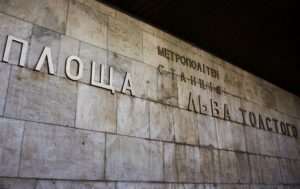
The station of the “blue” metro line “Ploscha Lyova Tolstoho”, which is named after the Russian writer, has now been renamed to its historical name – “Zvirynetska”.
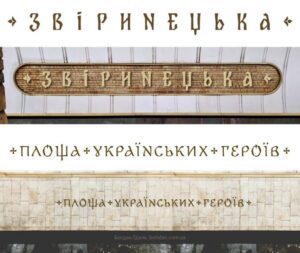
At the end of April 2023, Kyiv-based designer Bohdan Hdal designed a new font for the name of the “Square of Ukrainian Heroes” metro station. The font used to write the old name dates back to Stalin’s times and has somewhat sharp shapes for the sophisticated design of the station, Bohdan believes. Therefore, for the new name, he used the original historical shapes of some letters and a style from the early 20th century era of Narbut and Krychevsky. “To prevent the letters from feeling like a foreign body that the station’s immune system seems to reject, I decided to make them graceful,” the designer notes.
The author decided to convey the idea of heroism through certain symbols. In particular, through the Cossack cross, which is on the emblems of the Ukrainian Armed Forces, the Ministry of Internal Affairs, the Security Service of Ukraine, the coats of arms of some regions, etc.
However, the blue line of the metro has a so-called signature font, a geometric grotesque, which is used on the “Heroes of Dnipro”, “Minska”, and “Taras Shevchenko” lines.
In late May, the designer also proposed a design for the “Zvirynetska” metro station. According to the author, he was inspired by the font designed by Oleksandr Komiakhov, which the illustrator developed based on the wall paintings of the Refectory Church of the Kyiv Pechersk Lavra.
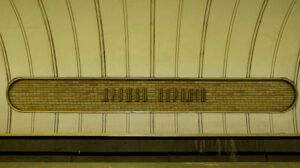
In response to Bohdan Hdal’s proposed font for the “Druzhby Narodiv” station, designer Timur Dzhafarov called for preserving the “modernist ligature” used for the station’s old name by architects Mykola Alyoshkin and Anatoliy Krushynsky. The inscription on the track wall is an element of the station’s architecture, the designer emphasized.
T. Dzhafarov, who is in the military service, presented a variant of the new name in the original style.

Author: Bohdan Gdal
“Most of the letters consist of two sticks. Most of the roundings are convex at the top and convex at the bottom. There are absolutely spontaneous actions, such as a round hole instead of a crossbar in “H”… These letters did not require additional “ukrainization” – it is literally a modernist view of the Old Slavonic script,” noted Dzhafarov.
The idea was developed by urban project designer Oleksandr Kolodko. In response to Dzhafarov’s post, he created his own version of adapting the new name in the same style that the architects had incorporated into the station’s design.
“In my opinion, this is not a case that needs to be rethought or redone, on the contrary, it is one of the things that should be preserved because it is a good example of modernism and a reflection of its time. Just like the Flowers of Ukraine building or the unique building of the bus fleet No. 7 need to be preserved,” Kolodko wrote.
What about the rights of station architects?
First, we need to understand whether a metro station is a work protected by copyright. According to the provisions of the current Law of Ukraine “On Copyright and Related Rights” (Article 3, paragraph 4, part 1, clause 4), which applies to the regulation of relations related to the use, among other things, of works of architecture and fine arts, the originals of which are located in Ukraine. A work of architecture is a work in the field of construction of buildings, urban planning, landscape art, landscape formations in the form of drawings, sketches, models, constructed buildings or structures, plans of settlements, etc. (Article 1(57) of the Law of Ukraine “On Copyright and Related Rights”). At the same time, works of architecture, urban planning, landscape art and landscape formations are also subject to copyright (Article 6(1)(11) of the Law of Ukraine “On Copyright and Related Rights”).
Thus, it can be concluded that a metro station is an architectural work in the field of urban planning in the form of a constructed structure, which is an object of copyright, and therefore protected by the Law of Ukraine “On Copyright and Related Rights”.
Accordingly, the primary subjects of copyright in relation to metro stations as objects of copyright are architects (authors) of metro stations, who, in turn, have copyright in the relevant work – metro stations, namely
– personal non-property rights of the author;
– property rights of copyright holders
according to part 1 of Article 5 of the Law of Ukraine “On Copyright and Related Rights”.
 In the context of the issue of changing the fonts of the renamed stations, the question arises: “Which of their rights can the authors (station architects) potentially invoke in demanding to preserve the original font?” The most likely option is the non-property right to the inviolability of a work. In the current Law “On Copyright and Related Rights”, Article 11, paragraph 4, part 1, this right is formulated as follows:
“4) the right to demand the preservation of the integrity of the work, to oppose any distortion, distortion or other alteration of the work, including accompanying the work with illustrations, prefaces, afterword, comments, etc. without the author’s consent”.
This wording reproduces Article 6bis(1) of the Berne Convention, even slightly expanding it. The Convention refers to the right of the author to object to the listed actions if they “would be prejudicial to his honor or reputation”, while the current Ukrainian law does not contain such a clarification (unlike the previous version of 2002).
Non-property rights of the author are based on the thesis that a work is an embodiment and a kind of “continuation” of the author’s personality. In the right to inviolability of a work, the subjective aspect of creativity, i.e. the author’s own creative intention as embodied in a particular work, becomes important.
Thus, it turns out that if station architects have the right to object to changing the original font, they can also oblige the subway to use it.
What decision did the architects take?
The architects of the stations, of course, took part in the decision on which font to choose: “Vadym Zhezherin for “Ploscha Ukrainskih Heroyiv” (formerly “Ploscha Lyova Tolstoho”), and Mykola Alyoshkin and Anatolii Krushynskyi for “Zvirynetska” (formerly “Druzhby Narodiv”). The authors of the latter asked that the letters be placed across the entire width of the brick niche, which Bohdan Hdal said he did.
Oleksandr Kolodko’s fonts were also offered for approval, as well as “all other possible options.” Kolodko himself, who proposed to keep the old font as an example of modernism, notes that Hdal’s options were approved with some modifications: “It’s a pity, of course, to lose the beautiful, distinctive letters from Druzhba Narodiv. But I have no questions about the process,” Kolodko comments.
Author: Bohdan Gdal
As a result, in July 2023, the architects chose the options proposed by Bohdan Hdal.
So, we see the Law of Ukraine “On Copyright and Related Rights” in action. After all, according to the current provisions of this Law, changes to the existing architectural design, including the architectural appearance of the name of a subway station, are made only in consultation with the architect of that station.
Although the final fonts for the “Ukrainian Heroes Square” and “Zvirynetska” metro stations have been approved for more than six months, as of the date of this article, “Zvirynetska” still has the name “Druzhby Narodiv”, while the letters of Ukrainian Heroes Square are still in regular font. At the same time, the specialists have already replaced the train direction signs on the track walls, put new names on the passenger direction signs, and updated the audio announcements of the stations in Ukrainian and English.
In addition, the subway’s press service informed that they are currently preparing the necessary documents for an open tender for the production of letters for track walls, taking into account all the features of the fonts and the specifics of further operation.
Architect / copyright / intellectual property / original font / subway


