
 Artificial intelligence (hereinafter “AI”) has long ceased to be a technology of the future. Today, AI creates text, music, images, and program code; analyzes large datasets; and is gradually transforming entire sectors of the economy. Along with these new opportunities come new legal challenges. One of the main challenges is how to strike a balance between technological development and the protection of the rights of authors, inventors, performers, and owners of other intellectual property.
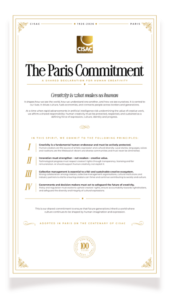
It was precisely these issues that were discussed at the global level during the Paris AI Summit, which resulted in the publication of the Paris Declaration on AI. The document is already being called one of the most important international guidelines for shaping future rules on the use of AI and the protection of intellectual property in the digital age.
What Is the Paris Declaration and Why Was It Adopted?
In February 2026, Paris hosted the AI Action Summit, an international gathering that brought together representatives from governments, international organizations, technology companies, scientists, and experts from around the world. One of the main topics was the need to develop common approaches to the development and regulation of AI.
Following the meeting, a document known as the Paris Declaration on AI was drafted. Its main idea is that the development of AI should not only be innovative, but also responsible, safe, and respectful of human rights and intellectual property rights. In fact, this marks the first time the global community has recognized, at such a high level, the need to establish common rules for technologies that are evolving much faster than legislation.
 The Role of Intellectual Property in the Declaration
One of the key issues raised during the summit was the use of intellectual property to train AI models.
Today, most generative systems are trained on massive datasets that include books, musical works, photographs, articles, scientific papers, videos, and other content. This has already led to numerous legal disputes between creators and AI developers around the world.
Summit participants emphasized that the development of AI should not come at the expense of creators’ rights. Innovation must go hand in hand with fair compensation for authors and rights holders whose works are used in the process of training algorithms.
In other words, the declaration supports the idea that intellectual property must remain one of the fundamental elements of the digital economy, even amid the rapid development of generative AI.
 Why This Document Is Important for Business and the Creative Industries
Although the Paris Declaration is not an international treaty and does not create direct legal obligations, its significance cannot be overstated.
Documents like this often serve as the foundation for future legislative changes at both the national and international levels. It is through such political declarations that principles are formed, which are later reflected in laws, regulations, and judicial practice.
For businesses, this means that requirements for the use of AI may become clearer in the coming years. Companies that develop AI solutions or use generative systems in their operations will increasingly face issues related to data origin, copyright compliance, and content licensing.
This is particularly relevant for the following sectors:
- the music industry;
- design and advertising;
- software;
- publishing;
- media and journalism;
- scientific research.
While many issues previously remained in a so-called “gray area,” the international community is now gradually moving toward establishing transparent rules for the use of content in artificial intelligence systems.
What Changes Can Copyright Holders Expect?
One of the main consequences of the development of such international initiatives could be the emergence of new content licensing mechanisms for AI purposes.
 Many countries are already discussing models under which authors and rights holders could receive compensation for the use of their works to train AI models. Issues of transparency are also being actively debated: should developers disclose the data sources used to train these systems?
In addition, increasing attention is being paid to the protection of human creative work. After all, the development of generative AI raises new questions: who is the author of the content created, can works created by AI be protected by copyright, and how can human creativity be distinguished from the results of algorithms?
Although there are no definitive answers yet, the Paris Declaration sets a general direction: the development of AI must take into account the interests of rights holders, rather than running counter to them.
Ukraine and the Future Regulation of AI
For Ukraine, participation in international discussions on AI is of particular importance. The Ukrainian IT sector actively uses AI solutions, and the creative industries are increasingly facing copyright issues regarding content created or processed using AI.
Therefore, international approaches—which are currently still taking shape only at the level of declarations and recommendations—may influence Ukrainian legislation in the future. Businesses should already be taking these trends into account and paying closer attention to intellectual property issues when using AI tools. After all, protecting rights to content, brands, software products, and innovative developments is gradually becoming one of the key factors in competitiveness within the digital economy.
 The Paris Declaration on AI sent an important signal to the entire world: technological development can no longer be viewed in isolation from intellectual property issues. Copyrights, patents, trademarks, and other intangible assets remain the foundation of the innovation-driven economy, even in the era of generative AI.
Although the document does not establish mandatory rules, it outlines the direction in which international regulation will move in the coming years. For businesses, creators, and developers, this means the need to start preparing today for new requirements and to approach the use of AI responsibly.
If you need advice on copyright, intellectual property protection, or the legal aspects of using AI in business, please contact our law firm. We will help you protect your rights and adapt to the new challenges of the digital age.
artificial intelligence / copyright / intellectual property / The Paris Declaration


